
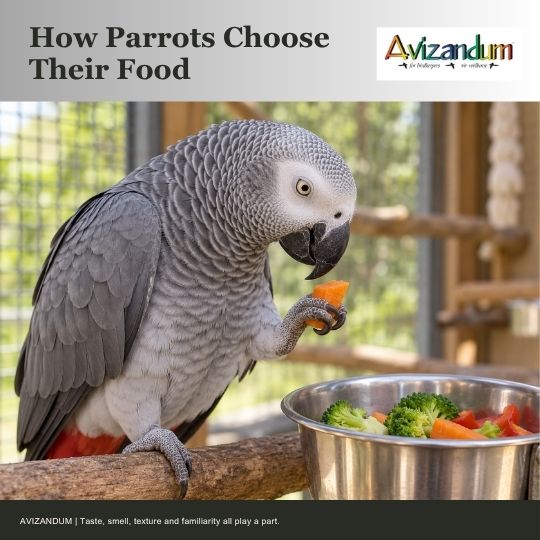
Why your parrot chooses one food and leaves another
You offer a fresh piece of carrot. Your parrot picks it up, rolls it against its tongue, takes a small bite and drops it. Another day, the same carrot, cut differently, gets eaten.
It is tempting to decide that the bird simply dislikes carrots. But food acceptance involves more than flavour. What a parrot sees, feels and recognises can influence whether it approaches a food, samples it or swallows it.
Understanding these senses can help us be more patient—and more observant—when introducing variety.
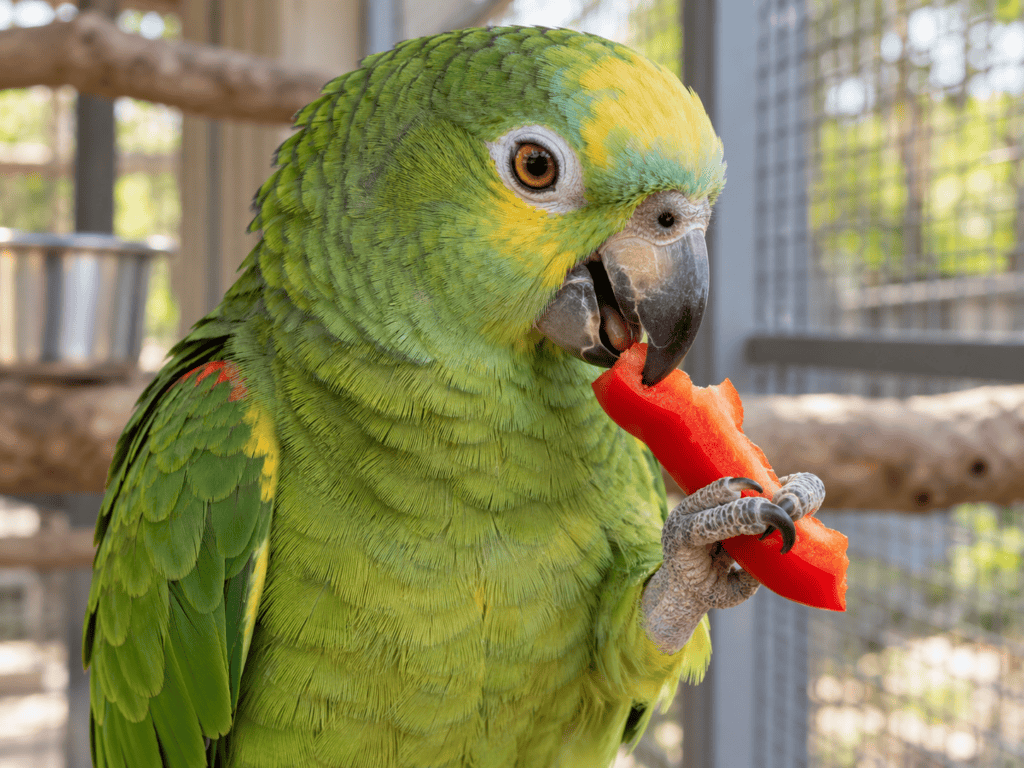
Can parrots taste?
Yes. Parrots have taste buds, but their arrangement differs from ours. In birds, many taste buds occur on the palate and around salivary gland openings, rather than being concentrated on the tongue as people often imagine. Saliva helps dissolved food compounds reach these receptors.
Having fewer taste buds than humans does not mean food is tasteless to a parrot. Nor does counting taste buds tell us exactly how strongly a bird experiences a particular flavour. Taste systems vary between species, and we cannot assume that every parrot experiences sweetness, bitterness or other tastes exactly as we do. [1]
Research also shows that flavour can matter to parrots. In a 2025 experiment, some Goffin’s cockatoos dipped food into soy yoghurt, with a preference for blueberry-flavoured over plain yoghurt that colour preference alone could not explain. The researchers interpreted this as evidence of food flavouring. This was a behavioural experiment, rather than a recommendation to feed yoghurt. [2]
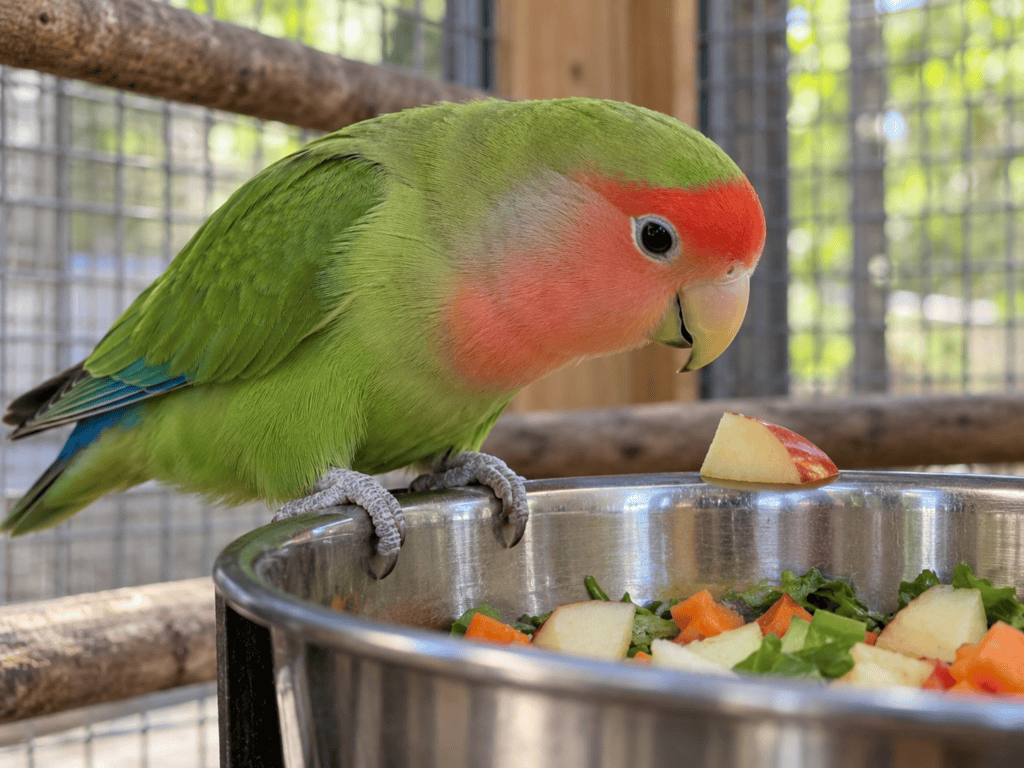
Can parrots smell their food?
Parrots have a sense of smell, although its importance in everyday food choices is still being investigated. Research on avian smell receptors challenges the old belief that birds generally cannot smell. However, smell sensitivity differs across bird species, and findings from one species should not be applied automatically to all parrots. [3]
Smell may contribute information about a food, but we cannot tell from watching a bird alone whether aroma, appearance or another cue prompted its decision. It would also be unsafe to assume that a parrot can reliably identify spoiled or harmful food by smell.
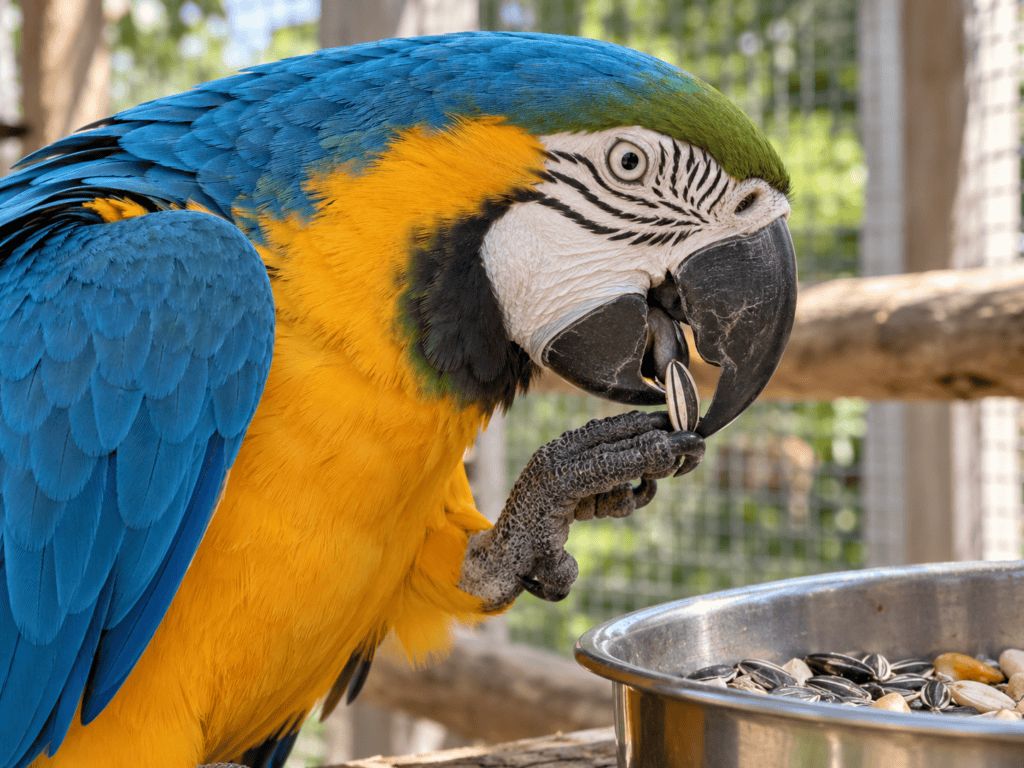
Can they feel sensations on their tongues?
Yes. A parrot’s tongue is a sensitive organ for touch as well as a tool for moving food.
Parrots have touch receptors in the tongue and beak. Their fleshy, mobile tongues help rotate food, position it against the palate and coordinate the removal of seed husks. Research describes a concentration of touch structures near the tongue tip and lower beak.
This sensory system helps a parrot assess and handle what is in its mouth. A hard seed, a soft piece of vegetable and a slippery piece of fruit present different physical challenges. When a bird rolls food around with its tongue, it is doing more than simply moving it towards the throat. [4]
Taste and touch are different senses: taste detects chemical compounds, while touch supplies information about contact, pressure and physical properties.
What about heat and the “burn” of chilli?
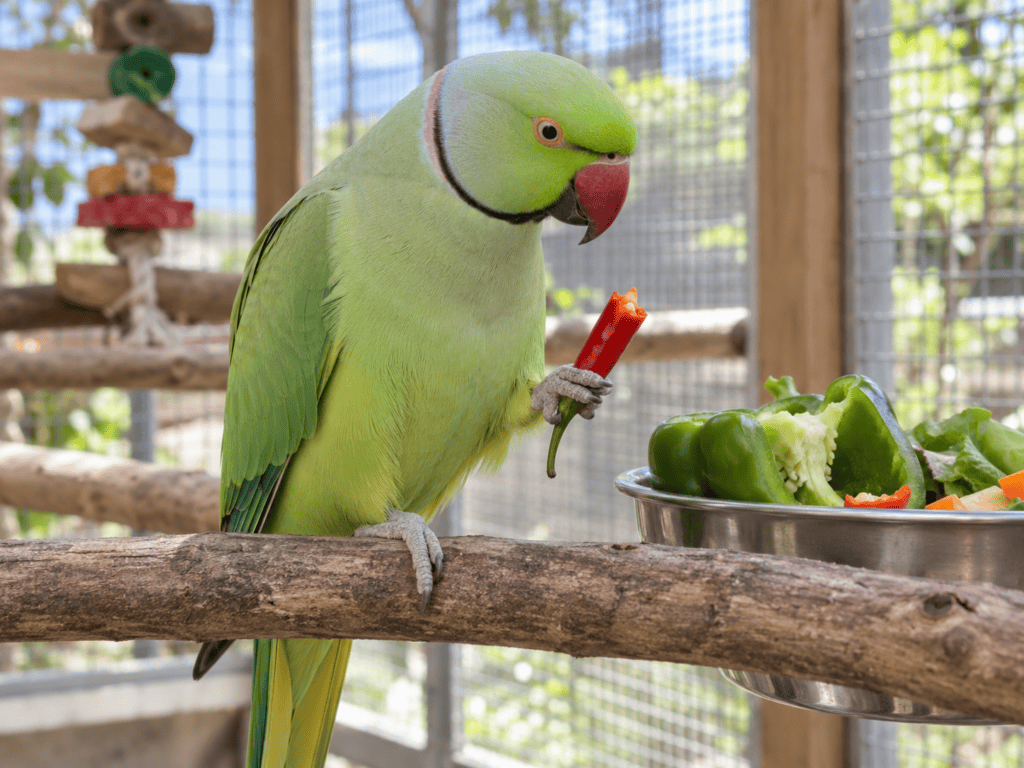
The burning sensation humans experience from chilli is caused by capsaicin activating sensory receptors. It is not a basic taste like sweetness.
Research on the chicken version of the TRPV1 receptor found that it was insensitive to capsaicin under the experimental conditions, while still responding to harmful heat. This helps explain why birds generally tolerate chilli’s pungency much better than mammals. It does not mean that birds cannot feel pain or that hot food cannot burn their mouths. [5]
For keepers, the distinction matters: chemical spiciness and actual food temperature are separate things. A bird’s response to chilli tells us little about whether a warm meal is safe to serve.
Colour and familiarity influence the decision too
A parrot can respond to a food before tasting it. Colour and previous experience may help it decide what to investigate.
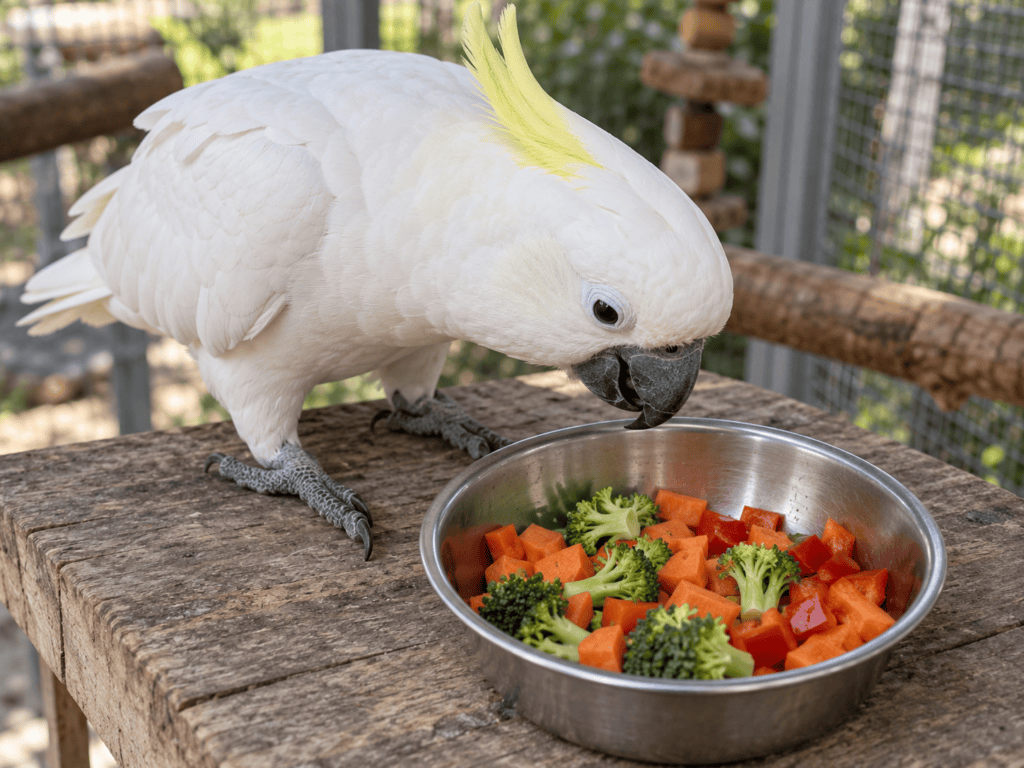
A study of wild sulphur-crested cockatoos using differently coloured novel foods found evidence of social learning. Younger birds were more likely to follow the food colour recently chosen by the majority. The findings show that food choices can reflect experience and social information, rather than flavour alone. They do not establish a favourite colour for all parrots. [6]
For a keeper, a first refusal may therefore mean “unfamiliar” rather than “unpleasant”. Changing the size, shape or preparation of a suitable food is a practical way to explore what an individual bird will accept.
Make new foods easier to explore
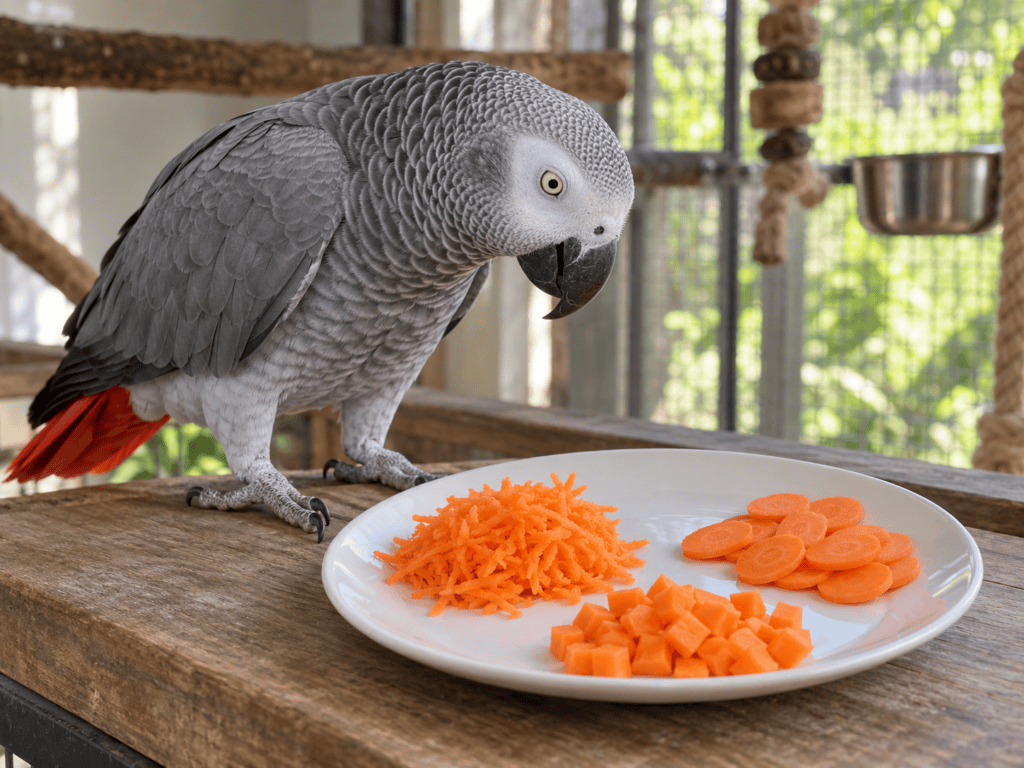
Offer small amounts of suitable new foods alongside the bird’s established diet. Try different presentations on separate occasions: a vegetable might be offered in a thin slice, a small piece or grated. Observe whether the bird approaches, touches, bites and actually swallows it.
Treat these as opportunities to learn about your bird, rather than proof that one presentation will work for every parrot.
During a substantial diet change, monitor actual intake and weigh the bird regularly on a gram scale. A bowl containing food does not guarantee that the bird is eating it. UC Davis recommends gradual diet conversion, close weight monitoring and veterinary guidance. [7]
The aim is to build acceptance of an appropriate, balanced diet. A parrot’s favourite food is useful information, but preference alone does not tell us whether its nutritional needs are being met.
Sources
- The avian taste system (2023)
- Innovative flavoring behavior in Goffin’s cockatoos (2025)
- Avian olfactory receptor gene repertoires (2008)
- The Independent Evolution of the Enlargement of the Principal Sensory Nucleus of the Trigeminal Nerve in Three Different Groups of Birds (2009)
- Molecular basis for species-specific sensitivity to “hot” chili peppers (2002)
- Wild parrots exhibit age-dependent conformity when learning about novel food (2026)
- Bird Diet Conversion — UC Davis School of Veterinary Medicine


