
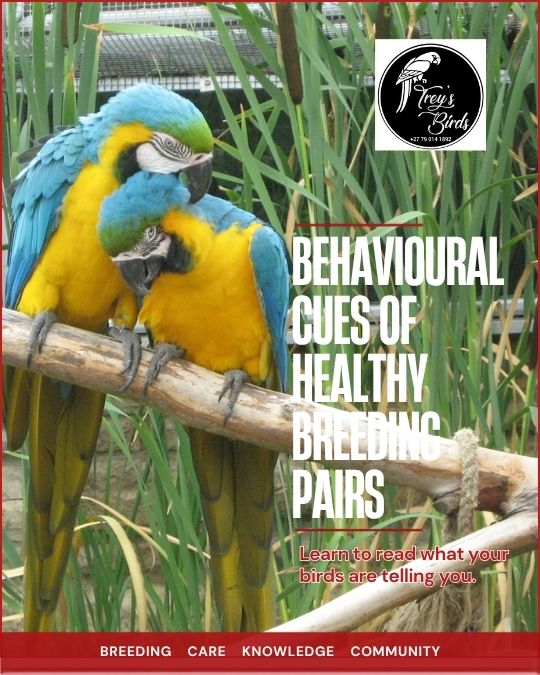
Behavioral Cues of Healthy Breeding Pairs
Trey’s Birds Educational Series – Promoting Ethical Aviculture & Education Across South Africa
Introduction: Breeding Success Starts with Behaviour
Successful breeding rarely begins with the nest box. It begins with behaviour.
Long before eggs appear, healthy and compatible breeding pairs often display subtle but valuable behavioural signals. Breeders who learn to recognise these cues can better understand the relationship between their birds, identify potential problems early and avoid wasting valuable breeding seasons.
Birds are often paired based primarily on confirmed sex, genetics, age and physical condition. While these factors are essential, behavioural compatibility is equally important. Even genetically suitable and physically healthy birds may struggle to breed if their social relationship is weak or mismatched.
Understanding normal pair-bonding behaviour gives breeders another important tool. It allows them to recognise when a pair is progressing naturally, when birds may need more time to settle and when environmental or behavioural problems may need attention.
The Foundation of Pair Bonding
In many avian species, successful breeding depends heavily on the strength of the pair bond.
A strong bond can encourage cooperation during:
- Courtship
- Mating
- Incubation
- Feeding and caring for chicks
- Defence of the nest area
Healthy pair bonding generally develops gradually rather than appearing overnight. Birds may initially tolerate one another before progressing to relaxed proximity, mutual interest and coordinated behaviour.
Rushing birds into breeding before they have established a comfortable relationship can contribute to problems such as aggression, nest abandonment or poor breeding results.
Patience during this stage can make a significant difference.
Positive Proximity Behaviour
One of the earliest signs of developing compatibility is voluntary close positioning.
Healthy pairs will often choose to perch near one another even when the enclosure provides enough space for them to remain apart. As familiarity and trust develop, the distance between the birds may gradually decrease.
Look for:
- Relaxed side-by-side perching
- Calm body posture when near one another
- Little or no defensive lunging
- No persistent avoidance
- Comfortable feeding in each other’s presence
- Birds voluntarily choosing to remain together
A pair that consistently remains at opposite ends of the enclosure for extended periods may not yet be fully bonded. However, distance alone should not be considered proof of incompatibility. Species, individual personality and environmental conditions must also be considered.
Mutual Preening
Allopreening, or mutual grooming, is an important social behaviour in many bird species and can be a strong indication of trust and social acceptance.
Preening often begins around the head and neck, areas that birds cannot easily reach themselves.
Positive signs include:
- Gentle grooming around the face and neck
- Both birds participating in the interaction
- Relaxed posture while being groomed
- Increasing frequency of mutual grooming
- No aggressive response during the interaction
The absence of mutual preening does not automatically mean that a pair will fail. Some individuals are simply less demonstrative than others.
However, when mutual preening is present alongside other positive behaviours, it can be an encouraging indication of a developing pair bond.
Courtship Feeding Behaviour
Courtship feeding is an important bonding behaviour in many parrots and other avian species.
In many parrots, the male may regurgitate food for the female, although courtship feeding patterns vary between species and individuals.
This behaviour can serve both social and nutritional functions and is often associated with increasing pair-bond strength.
Positive indicators include:
- One bird showing a clear interest in feeding its partner
- The receiving bird accepting the food calmly
- Repeated feeding interactions
- Relaxed body language
- Soft vocal communication accompanying the interaction
Courtship feeding can be a useful indication of bonding and breeding readiness, but it should not be used on its own to predict fertility or breeding success.
Vocal Communication Patterns
Bonded pairs often develop their own communication rhythm.
Rather than constant alarm calling or complete silence, compatible birds may exchange soft contact calls, particularly when they are temporarily separated within the enclosure.
Watch for:
- Gentle, low-intensity vocal exchanges
- One bird responding to the other’s calls
- Calm contact calling when separated
- Reduced alarm calling when together
- Relaxed vocalisation around the nest area
Persistent screaming, distress calls or a complete lack of social communication may indicate stress or discomfort.
However, vocal behaviour must always be interpreted within the context of the species and individual bird. Some species are naturally more vocal than others.
Nest Interest and Cooperative Investigation
As breeding readiness develops, compatible pairs may begin showing increased interest in the nest site.
This interest can develop gradually and may include both birds investigating or interacting with the nest area.
Early signs may include:
- Both birds inspecting the nest box
- Increased visits to the nest area
- The male spending time near or guarding the entrance
- The female spending increasing amounts of time inside
- Nest material manipulation where appropriate
- Increased interaction between the pair around the nest
Healthy nest interest should generally appear relaxed and progressive, rather than frantic or aggressively territorial.
If one bird shows strong interest while the other remains completely disengaged, the pair may still need additional time to develop their bond.
Body Language During the Breeding Phase
Body language provides breeders with continuous information about how birds are responding to one another.
Healthy breeding pairs generally display relaxed and coordinated behaviour.
Positive body language may include:
- Relaxed feather position
- Calm posture
- Smooth, coordinated movements
- Comfortable movement around one another
- Controlled courtship displays
- Willingness to remain in close proximity
Warning signs may include:
- Repeated defensive posturing
- Persistent lunging
- Avoidance flights
- Continuous chasing
- One bird consistently dominating the other
- One bird being repeatedly forced away from food or preferred perches
Occasional disagreements are normal. Persistent aggression is not something that should simply be ignored.
Mating Behaviour Indicators
When birds reach breeding readiness, mating behaviour may become more frequent and coordinated.
Positive signs can include:
- The male attempting to mount without persistent aggression
- The female displaying receptive behaviour
- Repeated successful mating attempts
- Calm behaviour following mating
- Continued positive interaction between the pair
Some brief disputes may occur before or after mating. These do not necessarily indicate that the pairing has failed.
However, persistent aggression associated with mating attempts should be treated as a warning sign.
Red Flags Breeders Should Watch For
Not every pairing progresses smoothly.
Recognising problems early can prevent unnecessary stress and help breeders make better decisions.
Warning behaviours include:
- Persistent aggression after the initial settling period
- One bird consistently driving the other away from food
- One bird being denied access to preferred perches
- Feather damage caused by the partner
- Persistent chasing
- Complete behavioural indifference after an extended period
- Continued nest-box avoidance
- Repeated breeding attempts without successful results
Repeated clear eggs, for example, should not automatically be attributed to behavioural incompatibility. Fertility, mating effectiveness, age, nutrition, reproductive health and environmental factors should also be considered.
When several warning signs occur together, it may be appropriate to reassess the pairing and, where necessary, seek professional veterinary or avicultural advice.
The Role of the Environment
Even a potentially compatible pair can display poor behaviour when environmental conditions are unsuitable.
Before deciding that a pair is incompatible, breeders should consider the environment surrounding them.
Common environmental stressors include:
- Excessive disturbance around the aviary
- Overcrowding
- Poor nest-box placement
- Predator activity
- Inconsistent routines
- Unstable lighting cycles
- Excessive handling
- Competition from neighbouring birds
A pair may behave very differently in a calm, predictable environment compared with one exposed to constant disturbance.
Before blaming the pair, review the environment.
Monitoring Without Over-Disturbance
Observation is one of the breeder’s most valuable tools, but too much interference can interfere with natural behaviour.
The goal is to observe enough to understand the birds without unnecessarily disturbing them.
Good monitoring practices include:
- Quiet daily observation periods
- Minimal disturbance around the nest during bonding
- Consistent daily routines
- Using visual checks rather than unnecessary handling
- Recording important behavioural changes
- Avoiding repeated nest inspections without a clear reason
A calm and consistent approach allows breeders to identify changes while reducing additional stress on the birds.
Building Breeder Intuition Over Time
Reading bird behaviour is a skill that develops through experience.
Keeping brief notes throughout the breeding season can help breeders recognise patterns that may otherwise be missed.
Record observations such as:
- Which pairs bond quickly
- Which birds take longer to settle
- When mutual preening begins
- When courtship feeding starts
- Changes in vocal communication
- When nest interest develops
- Which behaviours precede successful breeding
- Which warning signs appear before problems
Over several breeding seasons, these records can become an extremely valuable resource.
The goal is not to rely on one behaviour as a guarantee of success. Instead, breeders learn to recognise patterns of behaviour and understand each individual pair.
Final Thoughts
Behavioural cues provide an early window into the potential progress of a breeding pair.
Long before eggs appear, birds communicate through their actions. Proximity, grooming, courtship feeding, vocal communication, nest interest and body language can all provide useful information about the relationship developing between two birds.
Breeders who take the time to observe these behaviours can make more informed pairing decisions, identify potential problems earlier and give birds the time and environment they need to develop naturally.
Strong breeding results rarely come from luck alone.
They come from careful observation, patience, good husbandry and a willingness to listen to what the birds are communicating.
Trey’s Birds Educational Series
Breeding • Care • Knowledge • Community
A Trey’s Birds Initiative – Promoting Ethical Aviculture & Education Across South Africa
Disclaimer
The information shared in the Trey’s Birds Educational Series is provided for educational purposes only. It does not replace professional veterinary advice, diagnosis or treatment. Always consult a registered avian veterinarian for medical, behavioural or reproductive concerns involving your birds.


