
Help Science Unlock the Secret Behind Parrot Bill Colours
PASA and Avizandum encourage responsible breeders to be part of an exciting international scientific study.
Every aviculturist has looked at the brilliant red bill of a Lovebird or the striking orange bill of a Lory and admired the incredible colours nature has created. But surprisingly, scientists still don’t fully understand what pigments create these remarkable bill colours.
Researchers at Michigan State University are now working to answer that question, and they’re asking the global parrot breeding community to help.
A Chance for Breeders to Contribute to Science
For decades, aviculturists have contributed enormously to our understanding of bird breeding, genetics and behaviour. This project offers breeders another opportunity to make a lasting contribution—this time to international scientific research.
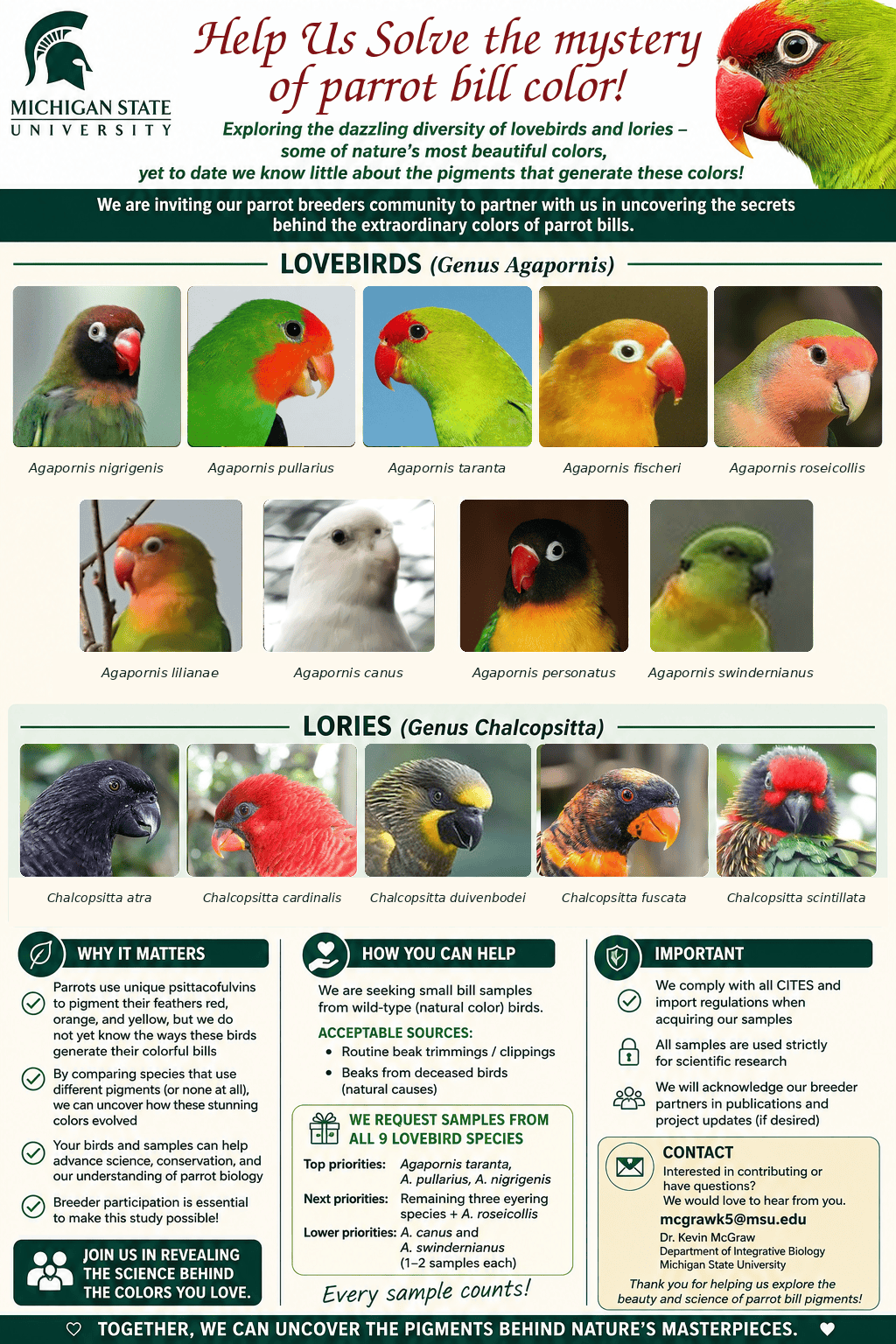
The study focuses on Lovebirds (Agapornis) and Lories (Chalcopsitta), comparing species with different bill colours to understand how these pigments evolved and how parrots produce them naturally.
The information gathered could improve our understanding of:
- Parrot biology
- Evolution of colour pigments
- Avian genetics
- Conservation science
- Future veterinary and research applications
What Samples Are Needed?
The researchers are not requesting live birds.
They are looking for small bill samples obtained through normal, ethical practices, including:
- Routine beak trimmings or clippings
- Beaks from birds that have died of natural causes
All samples should come from wild-type (natural colour) birds.
Priority species currently include:
- Agapornis taranta
- Agapornis pullarius
- Agapornis nigrigenis
However, samples from all Lovebird species are welcomed, while several Lory species are also part of the study.
Fully Legal and Ethical
Many breeders may wonder whether international regulations apply.
The researchers have confirmed that:
- All sample collection complies with CITES and import regulations.
- Samples are used only for scientific research.
- Participating breeders can be acknowledged in scientific publications and project updates if they wish.
Why PASA Supports This Initiative
One of PASA’s core objectives is to promote science-based aviculture.
Responsible aviculture has always played an important role in expanding our knowledge of parrots. Studies like this demonstrate that ethical breeders are valuable partners in conservation and scientific discovery.
Working together with researchers strengthens the relationship between aviculture and science while improving our understanding of the birds we care for every day.
How to Participate
If you keep any of the Lovebird or Lory species listed on the accompanying poster and are able to provide suitable samples, please contact Chane Viljoen via whatsapp on 082 052 5957.
Every suitable sample has the potential to help answer questions that have remained unsolved for generations.
Today’s beak trimming could become tomorrow’s scientific breakthrough.


